
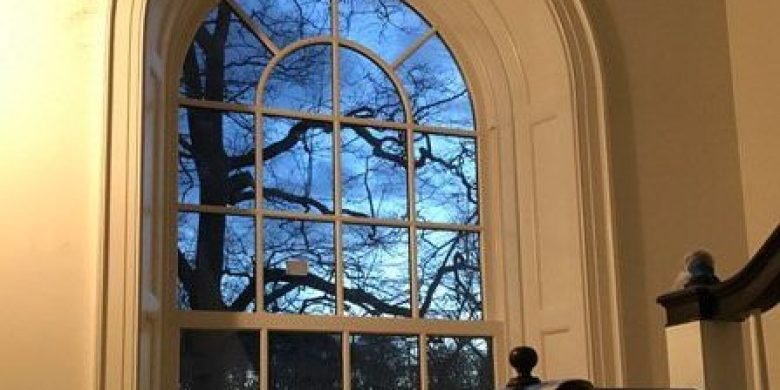
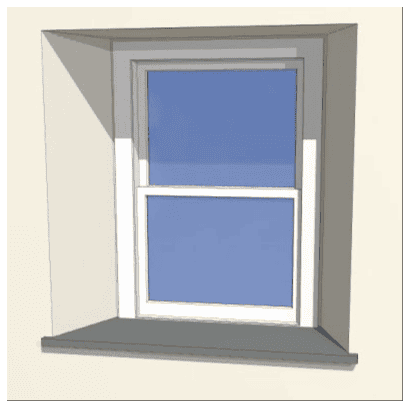
From inside the room, stand beside a window set into a thick masonry wall and look at the opening’s sides. Do they widen toward the room? If so, the wider portion of the opening gives a relatively small window a surprisingly generous presence inside.
That angled treatment is called a splay. This small detail has a long history, and it helps explain how builders made substantial walls more accommodating to daylight and improved the window’s view.
We often judge windows by their size, glass, or trim. The surrounding wall shape deserves attention, too. A window opening has depth, and what happens within that depth can change how a room feels.
What makes a window splayed
A splayed window opening has sides that angle outward rather than continuing square through the wall. In a familiar inward-splayed arrangement, the opening is narrower near the window and wider where it meets the interior wall surface.
The exposed surfaces between the window frame and the wall face are called reveals. The upright sides of the opening are its jambs. The “splayed window jamb” refers to the angled side; the “splayed reveal” describes how the exposed recess is treated. The sash itself can remain an ordinary rectangle. Imagine looking down at the wall from above. A straight opening resembles a short passage with parallel sides. A splayed opening fans out toward the room. Some openings flare toward the exterior, and a double-splayed opening widens toward both wall faces from a narrower point within the wall.
An old response to thick walls
The detail’s usefulness becomes clear in early masonry buildings. A deep, straight-sided opening can block light arriving at an angle and restrict views from positions beside the window. Widening the interior recess reduces that obstruction. The geometry helps explain why splayed openings were useful long before electric lighting.
Surviving buildings give us specific evidence. At Castle Rising in Norfolk, England, Historic England records narrow, internally splayed windows in the remains of an eleventh-century church. The neighboring castle keep, dated to about 1140, has three windows set within large splayed recesses along the Great Hall’s north wall. Its basement also has narrow openings that widen inward.
At St Oswald’s Church in Paddlesworth, Kent, the official listing records both single and double splayed windows. These variations remind us that historic builders used several arrangements rather than one standard detail.
These examples establish the feature’s long use. They do not establish a single inventor or a precise place of origin. Nor does the presence of a splay, by itself, date a building. It is a construction detail that architects have continued to use and reinterpret.
How the angle changes the room
Picture the same window in two otherwise identical thick walls. In one, the opening sides run straight into the room. In the other, they flare outward. From one side, the second opening can expose more of the glass and the view beyond it. That is the practical value of moving obstructing wall surfaces out of the way.
An inward splay can also allow daylight to reach parts of the room that a square reveal would shade. Light-colored reveal surfaces can reflect some of that light inward. The result depends on the opening’s depth and angle, the window’s position and orientation, and outside conditions. A splay does not enlarge the glass or guarantee a brighter room.
It also creates a visual effect. Light falling across an angled surface reveals the wall’s depth. From inside, the opening can feel generous while remaining relatively restrained on the exterior. As the daylight changes, the recess becomes part of the room’s changing pattern of light and shade.
An old detail in contemporary architecture
The architectural practice McGonigle McGrath explores this relationship in its essay “The Splayed Reveal.” The architects describe how memories of deep windows in Irish vernacular stone buildings influenced their own work. At their house at Ballyscullion, near Lough Beg, the splayed reveal shapes how light is received and how the landscape is viewed. It also contributes to the exterior composition.
The essay looks beyond splays to the broader importance of window depth and placement, including work by Sigurd Lewerentz and Jørn Utzon. That distinction matters: a deep recess is not automatically a splayed recess. Depth describes how far the opening extends through the wall; splay describes its angle.
For a homeowner, builder, or someone who simply enjoys old buildings, this offers another way to look at a window. Notice where the glass sits within the wall. Look at the side angles. Move a few steps across the room and watch how the visible landscape changes.
When remodeling an older building, consider the recess alongside the window unit. Squaring off an angled opening can change both its appearance and how light reaches the room. Understanding the existing detail is a useful first step before deciding what to preserve or alter.
That’s why a term like “splayed window jamb” is worth knowing. It names a deliberate building choice. Once you recognize it, you begin to see how much thought can be contained in the few inches between a window and the room around it.