
Brick Pointing vs. Tuckpointing

Should we use the terms interchangeably? In the world of masonry, terminology can often lead to confusion, especially when the same term is used to describe different techniques depending on region or context. Two commonly interchanged terms are “Brick Pointing†and “Tuckpointing.” While they’re sometimes used synonymously in the U.S., they actually refer to distinct […]
Pros and Cons of Ivy Growing on Your Brick

If you’re considering buying a home with ivy-covered exterior walls, know that a visual inspection cannot address hidden defects. Ivy can cover important information you may need to consider during the investigative process, most commonly cracks and painted surfaces. If I can’t see it, I can’t report it.
Efflorescence in Concrete and Brick

When I inspect and report the surface conditions of brick and concrete, and use the term efflorescence, it has more aesthetic rather than structural consequences.
Examples of Rusticated Masonry and Stone

Rustication is a range of masonry techniques giving visible surfaces a finish that contrasts in texture with the smoothly finished, squared-block masonry surfaces called ashlar.
What is a Quoin corner
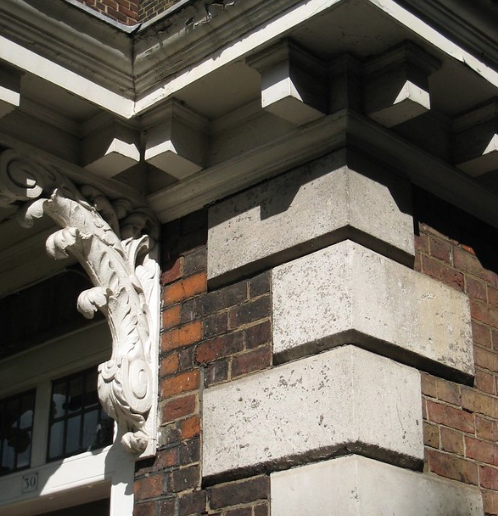
Quoin has come to be known as the accentuation of a building’s corner with short side header bricks or stone blocks and long side stretcher bricks or stone blocks that may or may not differ from the wall masonry in size, color, or texture.